Billing Code Guide
Billed for OEM Parts but Mechanic Used Aftermarket? How to Read Your Repair Order
If your invoice charged OEM prices but the installed part was aftermarket, recycled, or unlabeled, ask for supplier invoices, part numbers, and the disclosure you signed.
Executive Summary
Quick Summary- If you were billed for OEM parts but suspect aftermarket parts were installed, the most direct move is to demand the supplier invoice, installed part number, and signed disclosure showing you approved that part type.
- Many states require repair invoices to identify whether parts are new, used, rebuilt, reconditioned, OEM, or non-OEM.
- The shop's burden is documentation: part origin, supplier, price basis, and authorization.
- GetTrueCharge can scan the estimate and invoice to surface part-origin mismatches and write the document request.
Check your exact bill
Upload your repair order. We show a free preview of the strongest labor, part, or junk-fee issue before checkout.
Direct answer
Words on the Invoice That Matter
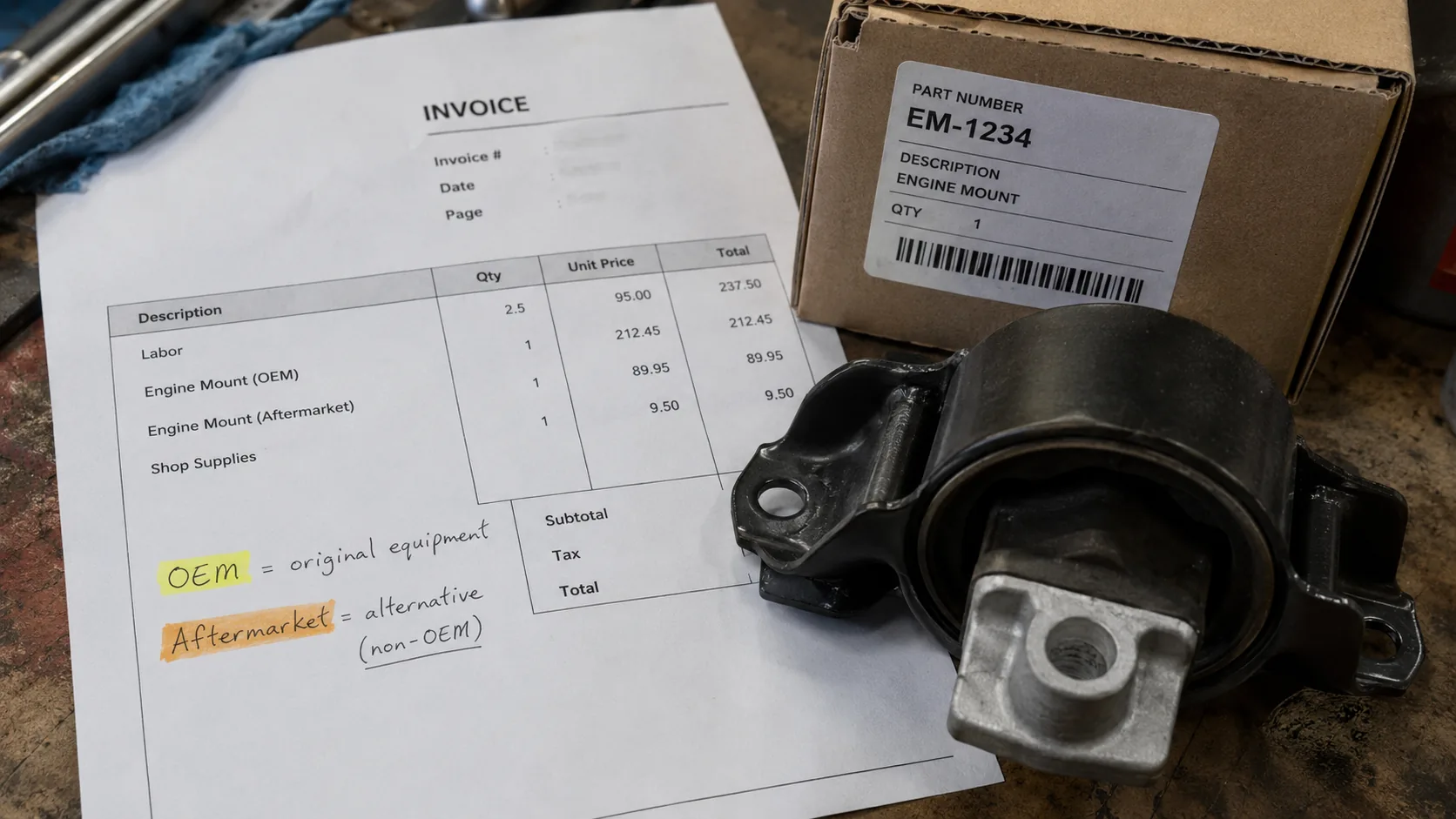
Part-origin fraud often hides in vague wording. A line that says replacement bumper, quality part, alternate part, or reman unit may not mean OEM. The invoice should make the origin clear enough for you to compare what you approved against what was installed.
| Term | Common meaning | Proof to request |
|---|---|---|
| OEM | New part from vehicle manufacturer or authorized channel | Dealer or OEM supplier invoice |
| Aftermarket | Third-party replacement part | Brand, part number, warranty sheet |
| LKQ or recycled | Used part from salvage or like-kind source | Recycler invoice and condition grade |
Evidence
The Supplier Invoice Is the Key Document
The repair invoice tells you what the shop charged you. The supplier invoice tells you what the shop bought. When those two documents point to different part categories, you have a concrete dispute.
- Ask for supplier invoices for every disputed part.
- Compare part numbers against OEM catalogs or the part packaging.
- Ask whether the old part is available for inspection or was retained as a core.
- Request the signed disclosure if aftermarket, recycled, rebuilt, or remanufactured parts were used.
Tool
Turn Part-Number Confusion Into a Written Demand
Frequently Asked Questions
Is aftermarket always worse than OEM?
No. The dispute is not that aftermarket parts are always improper. The dispute is whether the shop billed and disclosed the part type accurately.
What if insurance required aftermarket parts?
Ask for the insurance estimate, supplement, and disclosure. The final invoice should still identify the installed part type accurately.
Can I ask for the old parts?
In many repair transactions, you can request replaced parts before or at authorization, subject to core, warranty, and safety limits. Ask the shop in writing.
Sources Cited
Write It Right: Automotive Repair Dealer Documentation
California Bureau of Automotive RepairOfficial repair-order, estimate, authorization, parts, and invoice guidance for automotive repair dealers.
Motor Vehicle Repair Act
Florida LegislatureState repair-act framework covering written estimates, authorization, invoices, and consumer notice rules.
Labor Times
Mitchell 1Industry estimating context for labor-time databases used by shops and service writers.
Looking Up Part Prices and Labor Times
ALLDATARepair database documentation showing how shops locate labor operations, parts, and repair information.
Overlap in CCC ONE
Database Enhancement GatewayIndustry database guidance on collision estimating overlap and deductions for related operations.
Disclaimer
This article is educational information, not legal, financial, insurance, or automotive repair advice. Repair laws vary by state and facts. GetTrueCharge provides document review and dispute drafting support, but does not guarantee a refund or invoice adjustment.
Related Audits
Mechanic Charged 3 Hours of Labor for a 45-Minute Job: The Book Time Scam Explained
A mechanic can bill book time instead of clock time, but the invoice still has to match the estimate, labor guide, and authorization. Here is what to request before paying inflated labor.
Read guide
Shop Wants to Charge a Diagnosis Fee on Top of the Repair Cost? Why You Shouldn't Pay Twice
A diagnostic fee can be legitimate, but it becomes a double charge when the same teardown or test labor is also included in the repair labor.
Read guide
What Is a Shop Supplies Fee and Why Did My Mechanic Charge Me 15 Percent Extra For It?
A shop supplies fee can be a hidden junk-fee line when it is percentage-based, unitemized, or missing from the written estimate.
Read guide
Auto Body Shop Charged for Labor Overlap on Bumper and Fender: How to Prove They Double-Dipped
Collision estimates should account for overlapping labor when related panels come off together. Ask for the estimating worksheet, overlap deductions, and database notes.
Read guide