Billing Code Guide
How to Dispute CPT 99285 on an Emergency Room Bill
Learn when CPT 99285 may be worth questioning, what evidence to request, and how to route your bill into GetTrueCharge for a charge-specific audit.
Executive Summary
Quick Summary- CPT 99285 is the highest emergency department evaluation and management level, so it should be supported by high-complexity medical decision making or clearly documented high-risk presentation.
- A patient should not assume CPT 99285 is wrong just because the visit felt short; the strongest dispute asks for documentation, coding rationale, itemization, and insurance adjudication records.
- If the bill also includes out-of-network emergency, facility, observation, supply, or administrative add-on charges, the No Surprises Act and price-transparency rules may create additional leverage.
- GetTrueCharge can scan the actual bill and produce a dispute packet after showing a free preview of the strongest specific charge.
Check your exact bill
Upload your bill or EOB. We show a free preview of the strongest billing issue before you decide to unlock the dispute packet.
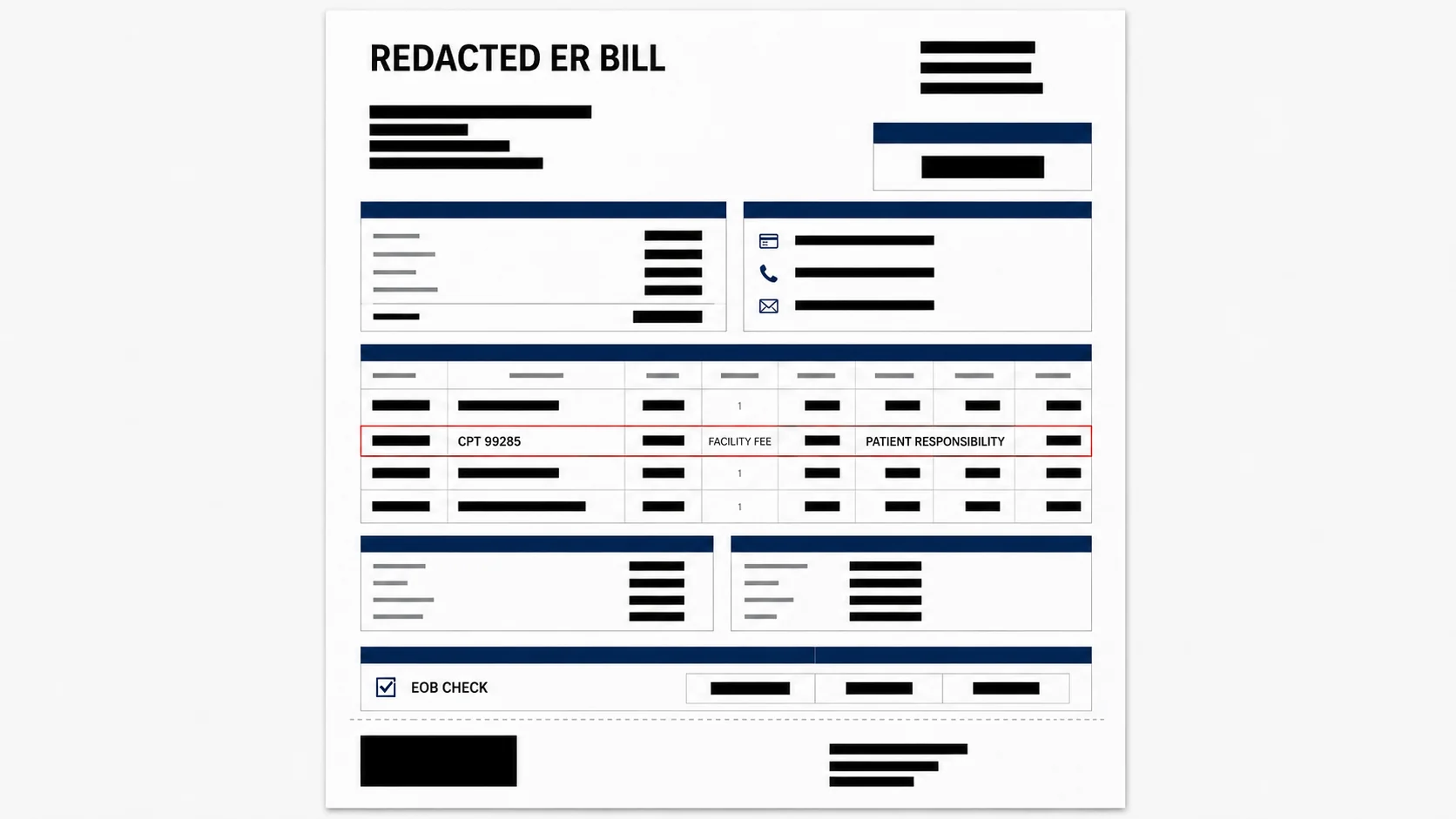
Billing code
What CPT 99285 Usually Means
CPT 99285 is commonly used for a high-severity emergency department visit. The code can be appropriate when the record supports high-complexity medical decision making, a serious presenting problem, or intensive diagnostic workup. It becomes worth reviewing when the bill gives you no itemized explanation, when the symptoms appear minor, or when multiple facility and physician charges stack on top of the same visit.
| Code | Typical use | Review signal | Evidence to request |
|---|---|---|---|
| 99283 | Moderate ED visit | Simple treatment or limited diagnostics | Provider note and medical decision making |
| 99284 | Higher severity ED visit | Multiple tests but limited risk | Coding rationale and diagnosis list |
| 99285 | Highest ED E/M level | High charge without high-risk documentation | Full chart, coding audit, and itemized bill |
| Data point | Why it matters | How to use it |
|---|---|---|
| CPT 99285 is the top ED evaluation level | Highest-level coding needs stronger documentation than routine triage or simple discharge care. | Ask billing for the medical-decision-making facts that justify the highest emergency level. |
| OIG oversight targets high-level E/M billing and coding-intensity risk | Federal oversight treats high-level evaluation coding as a recurring audit category, not a niche consumer complaint. | Frame the dispute as a documentation request, not a blanket accusation. |
| GetTrueCharge flags CPT 99285 only after a 7-field mismatch check | The audit compares code level, diagnosis severity, discharge status, patient balance, EOB allowed amount, facility fee stacking, and missing documentation signals. | Upload the bill and EOB together so the audit can compare billed level, allowed amount, and patient balance. |
Dispute signals
When CPT 99285 Is Worth Questioning
The strongest dispute is not "this seems expensive." It is "please show the documentation that supports this exact billing level." That phrasing keeps the request factual and hard for a billing department to dismiss.
- The ER visit was coded at CPT 99285 but the record shows limited exam, limited testing, and a stable discharge.
- The hospital charged a high facility fee and the physician group also billed a high evaluation code for the same encounter.
- The bill includes out-of-network emergency charges even though the hospital was in-network or the patient had no choice of physician.
- The bill lacks an itemized statement, CPT/HCPCS code detail, diagnosis codes, or explanation of benefits alignment.
Need the exact charge checked?
Run the hospital bill audit
Evidence
Documents to Request Before You Pay
| Document | Why it matters | Request phrase |
|---|---|---|
| Itemized bill | Shows CPT, HCPCS, supplies, facility fees, and add-ons | Please provide a full itemized bill with codes. |
| Provider chart | Shows medical decision making behind CPT 99285 | Please provide records supporting the emergency level billed. |
| Coding audit | Forces the provider to explain the code selection | Please provide the coding rationale for CPT 99285. |
| EOB | Shows insurer allowed amount and patient responsibility | Please reconcile this bill with my explanation of benefits. |
High-intent shortcut
If you already have the bill, upload the bill and the EOB together. The audit is stronger when it can compare the hospital charge, insurer adjustment, and patient responsibility.
Action
Dispute Language That Stays Factual
A useful dispute letter should ask for evidence and correction, not accuse the provider without proof. Keep the letter specific: name the code, name the bill number, cite the patient responsibility, and demand the record that supports the charge.
- Request a written explanation of why CPT 99285 was selected.
- Request a revised statement if the documentation supports a lower level.
- Request a pause on collection activity while the charge is under review.
- Attach the original bill and any explanation of benefits so the billing team cannot claim missing context.
Frequently Asked Questions
Is CPT 99285 always an overcharge?
No. CPT 99285 can be appropriate for high-severity emergency visits. It is worth disputing when the bill or records do not clearly support the highest emergency department level.
Can I dispute CPT 99285 without a lawyer?
Yes. Most first-step disputes are written billing and documentation requests. You can ask the hospital or physician group to justify the code and issue a revised statement if the documentation does not support it.
What should I upload to GetTrueCharge?
Upload the itemized bill, explanation of benefits, and clear photos or PDFs showing totals, line items, CPT/HCPCS codes, network status, and patient responsibility.
Sources Cited
No Surprises Act consumer protections
Centers for Medicare & Medicaid ServicesFederal guidance on surprise billing protections, emergency services, and consumer dispute paths.
Hospital Price Transparency
Centers for Medicare & Medicaid ServicesCMS requirements for hospital standard charges and consumer-friendly pricing information.
Medicare Claims Processing Manual
Centers for Medicare & Medicaid ServicesPrimary CMS manual source for claims-processing context and billing documentation expectations.
Coding intensity and evaluation management oversight
U.S. Department of Health and Human Services Office of Inspector GeneralOIG work-plan context for evaluation and management billing review and upcoding oversight.
Disclaimer
This article is educational information, not legal, medical, financial, or coding advice. Billing rules vary by payer, provider, state, and facts. GetTrueCharge provides document review and dispute drafting support, but does not guarantee a billing adjustment.
Related Audits
How the No Surprises Act Applies to Emergency Room Bills
A practical guide to No Surprises Act signals on ER bills, including out-of-network physicians, facility-based charges, and documentation requests.
Read guide
How to Request an Itemized Hospital Bill Before Paying
Use this checklist to request CPT codes, facility charges, supplies, administrative fees, taxes, and EOB reconciliation before paying a hospital bill.
Read guide
Charged for a Level 5 ER Visit but Only Saw a Nurse for 8 Minutes? How to Spot Upcoding
A Level 5 ER charge should be supported by high-complexity emergency documentation. If the record shows brief triage care, request the chart, facility-level matrix, and coding rationale.
Read guide
Why Your Hospital Bill Has Two Separate Charges for the Same Doctor Visit
A provider fee and facility fee can appear for one visit. Dispute the facility fee when the site, notice, EOB, or provider-based status does not support the extra charge.
Read guide
My Hospital Bill Has a $9,000 Observation Charge and I Was Never Admitted
Observation status can create large outpatient charges. Ask for the observation order, MOON notice when applicable, hourly codes, and admission-review rationale.
Read guide
Hospital Charged Me for Tests I Never Got: CT Scan, Labs, EKG, and How to Prove It
A test charge should match an order, result, report, or chart entry. If the bill lists tests you never received, request the medical record and itemized code support.
Read guide
Billed $1,150 for a Level 3 ER Visit After Just an Eye Exam: How to Fight Back
A Level 3 ER visit should reflect documented evaluation and resource use. If the visit was a simple eye exam, request the chart and facility-level rationale.
Read guide